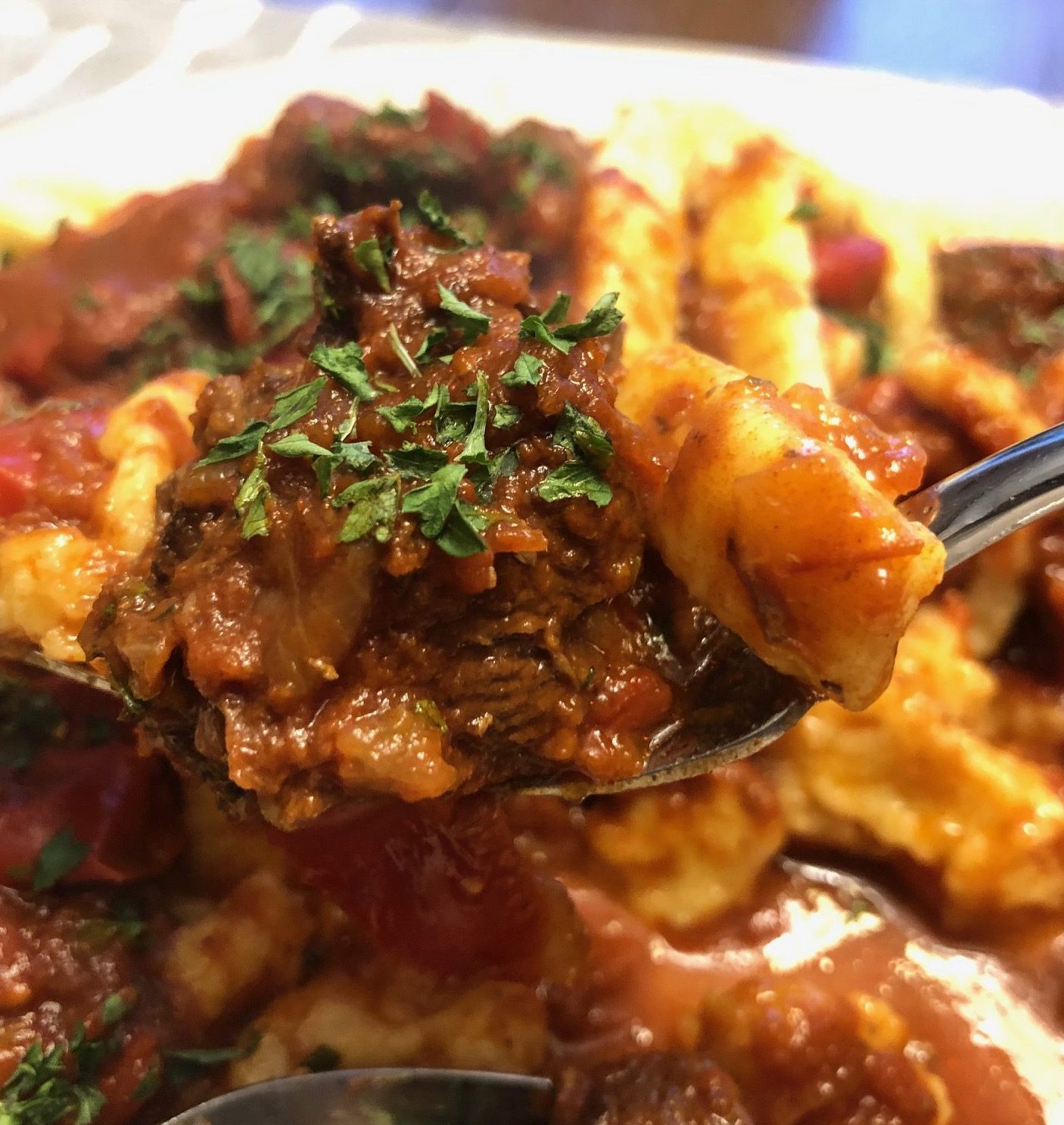
Canada Goose Paprikash with German Spaetzle

I was laying in bed the other night, thumbing through Instagram in a state of voluntary social distancing, when I came across a post from @TheFreeloadingGoat showing a very appealing plate of Hungarian goulash. Canada Goose Hungarian goulash.

Now I do like goulash, but if there is one issue I have with it (and I’m really quibbling here) it is that it is not quite hearty enough for me. I’ve had excellent goulash dishes in Hamilton, Ontario at the venerable Black Forest Inn, as well as at the very generous Two Goblets in Kitchener, Ontario and both were as authentic as you could find. But I wanted something just a little heavier, a little more emphatic, and I remembered another Hungarian dish, Chicken Paprikash, that was just a little more substantial. The flavors stronger, with thicker gravy that was, as I recalled, more tomato-based.

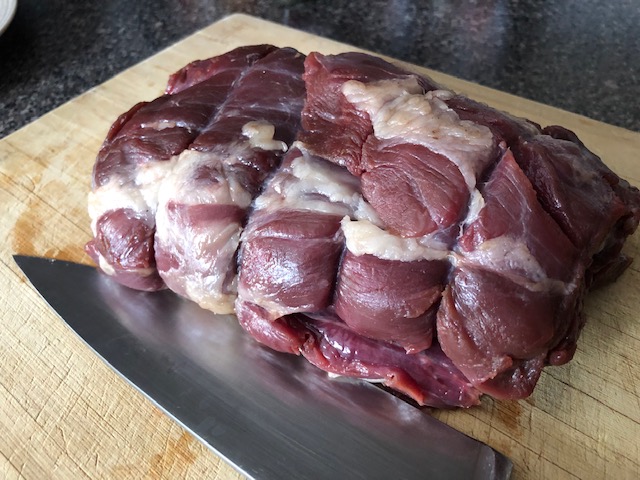
And I had plenty of Canada Goose meat in order to make this happen.

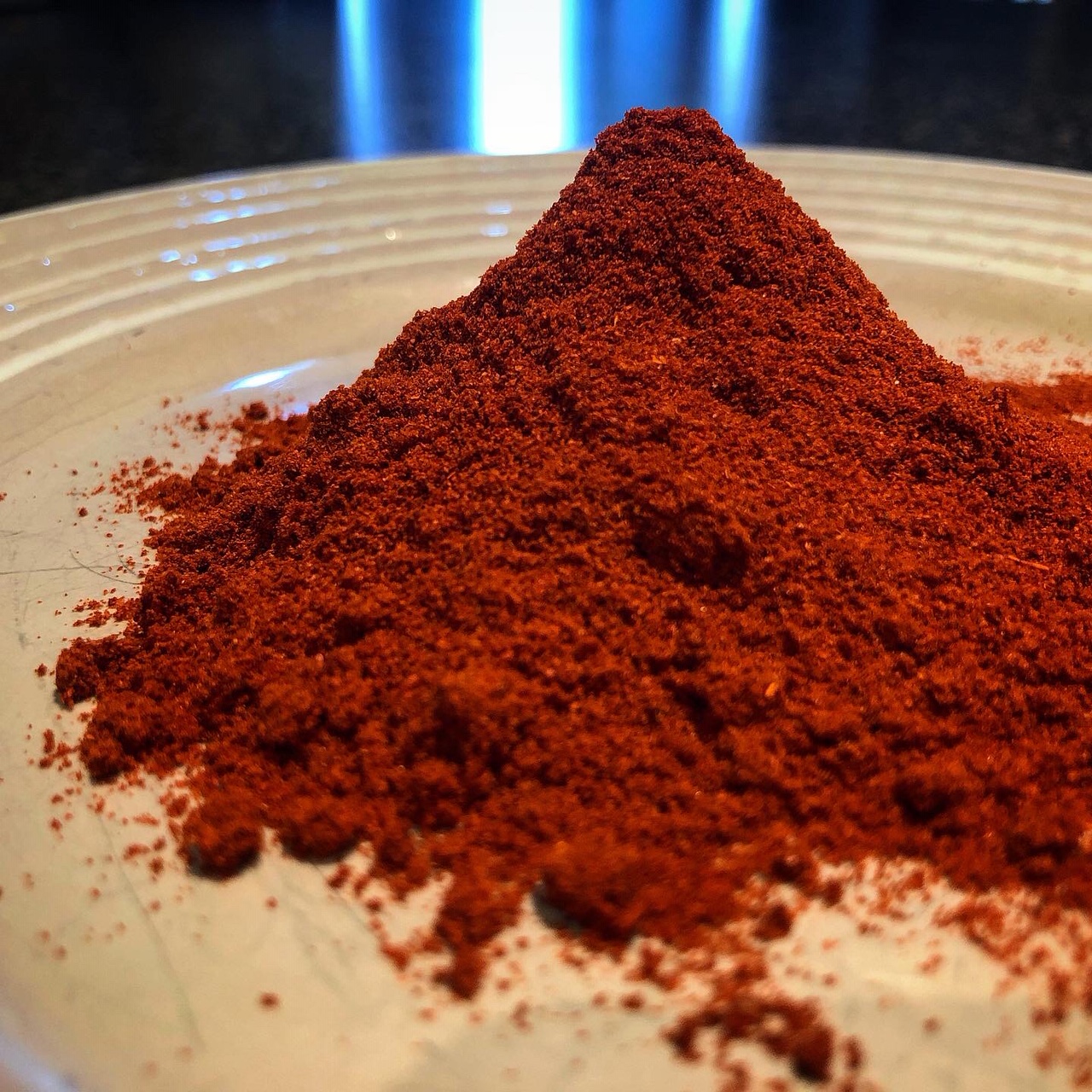
Paprikash is pretty simple when you get down to it, but it is in the simple use of good ingredients that have ended up as some of my favourite plates.  This stew was rich, filling, and paired perfectly with a Pilsner Urquell.  Of note, this recipe uses smoked paprika because that’s what prefer, but mild/sweet or hot and spicy paprika could be substituted in based on your personal taste.
Where I absolutely agreed with the post I saw was that this rich stew was going to have to go over spaetzle. That meant making some spaetzle, and I have always failed horribly at those elusive but oh so yummy German noodles.  I once tried to make them using a colander, but I ended up less with noodles and more with little boiled dough-balls. Another time I found a ‘hack’ saying that a box cheese grater would do the trick. I won’t speak of the outcome other than to say it did not do the trick I thought it would.

Undeterred I resolved to try again, and this time I found success. My trick? I cut the corner off a zip-top plastic bag and made it into a sort of piping bag.  From there I just piped the noodle batter into simmering water and waited for the magic to happen. Turns out spaetzle is pretty simple too.

As we all find ourselves (hopefully temporarily) social distancing, hunters are uniquely positioned in that we are not as fully at the whims of the supply chain, and we can often rely on some of our own wild caught or shot protein when heading out to grocery stores is less of an option. If you have some Canada goose breasts in your chest freezer, pull them out and turn them into this. You won’t be sorry.

As an added bonus, this recipe makes a big pot of paprikash, so there will be extras. I re-heated the leftovers tonight, then poured them over some savory pancakes and put a fried egg on top of the whole thing.  I can assure you this dish gets even better after a couple of days in the fridge.

Goose Paprikash

2 tbsp vegetable oil

3 medium sized Canada goose breasts, chopped into rough cubes

1 large onion, minced

3 large garlic cloves, crushed

2 medium red bell pepper, chopped

4 tbsp smoked paprika

2 tsp caraway seeds

1 can tomato paste (156ml)

1 can of diced tomatoes (796ml)

Salt and black pepper to taste

1 tbsp chopped fresh parsley

  1. Heat 1tbsp of the oil over medium-high heat in dutch oven or stock pot.
  2. Add the goose meat, browning it on all sides in batches, ensuring not to overcrowd the pot. Set aside the browned meat.
  3. In the same pot, add the remaining oil and heat the onions and peppers until they are softened, but still slightly crisp.
  4. Lower the heat to medium-low and add the garlic, stirring it until it starts to soften, then re-add the meat.
  5. Add the can of tomato paste and stir the meat and vegetables together until they are all coated.
  6. Add all of the paprika and the caraway seeds, and again stir until everything is coated.
  7. Pour in the can of diced tomatoes. Depending on the size of your pot, the goose and vegetables should be just barely covered, but if not, add a little water or red wine.
  8. Cover and simmer over low heat for at least two hours, or until the goose meat pulls apart easily with two forks.

Spaetzle

2 cups all-purpose flour

4 eggs

½ cup of water

2tsp kosher salt

2tsp butter

  1. In a mixing bowl, stir the flour and salt together, then make a little well in the center.
  2. Beat the eggs with a fork and add pour them into the well, along with some of the water.
  3. Using the handle of a wooden spoon, stir this until a thick, stretchy batter begins to form. Add some, or all of the rest of the water if it is too dry.
  4. Heat four cups of salted water to just below a boil.
  5. Stir for five minutes until it begins too look stretchy, then put it into a large, sturdy, zip-top plastic bag.
  6. Snip one corner of the bag, leaving a hole roughly the size of a pinky finger.
  7. Squeeze the dough through the hole in the plastic bag slowly, snipping off noodles about an inch long.
  8. When the noodles float and are firm to the touch, remove them to a colander and let them drain.
  9. Heat the butter over medium heat until it melts completely and foams.
  10. Add the spaetzle to the butter, tossing for two or three minutes until they are coated.

Serving

  1. Put a layer of spaetzle on a big plate.
  2. Pour the paprikash over top.
  3. Sprinkle with parsley.
  4. Eat it greedily while not speaking to anyone else at your table.
Black Bear Bourguignon

There had been four shots all told, and whomever had fired them had not been sitting too far away me. The startled adrenaline was flowing as I quickly went through the mental mathematics on who it could have been, all the while readying my own rifle in case the deer came running past my stand.

It was a cool and calm November evening, the first we had experienced so far for the 2019 deer season, and I strained my ears for hooves thumping through leaves or the snapping of twigs that happen when fleeing whitetails move fast and heedlessly from danger. The reports had come with the cadence of an autoloading rifle, and that disqualified a few hunters in the group from being responsible, and only two or three hunters would be in the vicinity of where all the action was happening so I had my list of suspects fairly soon.

Calming down in the silent minutes after all the noise and having had nothing sprint through the hardwoods around me, I pulled out my phone and texted the group. No one that responded fessed up, so I went back to my business of peering through the woods as darkness descended around me. Before I even broke out of the woods and into the field surrounding the cabin, I could hear the stories being told.

Someone had seen some shooting, and I hoped to find a deer gutted and in the hanging tree. To my surprise though, we were soon talking about a bear, and the only man in camp holding a tag for one was my dad.

The tale was not without drama, and those details are for another day, but when all was said and done, I was happy for dad to get his bear, but I was most excited for the bear meat. I already had my mind well set on a special type of dish. Now, eating predators gets a bad wrap in some circles, and bears in general get their share of flack. But a truly wild bear, cooked correctly, is a rich and complex meat, and to the non-hunter it is not dissimilar to beef.

I have been fortunate enough to have had slow roasted bear, BBQ pulled bear, and bear burgers, and all were exceptional, and yes all were “beefy”, but they were also all deeper than that. I cannot find the word to exactly do the taste justice but heavy, musty, intense, and rich all come to mind, all with the most positive of meanings.

I have always thought that bear stew would be excellent, and I fiddled with Irish Bear Stew or maybe a Bear Brunswick Stew, and those would be excellent choices, but they were just too rough in my mind. As an experiment, I wanted something just slightly more refined, something still rustic but also elegant that would be a way to show that all those bold and concentrated bear flavours could be married with something luxurious and a cut above “stew”.

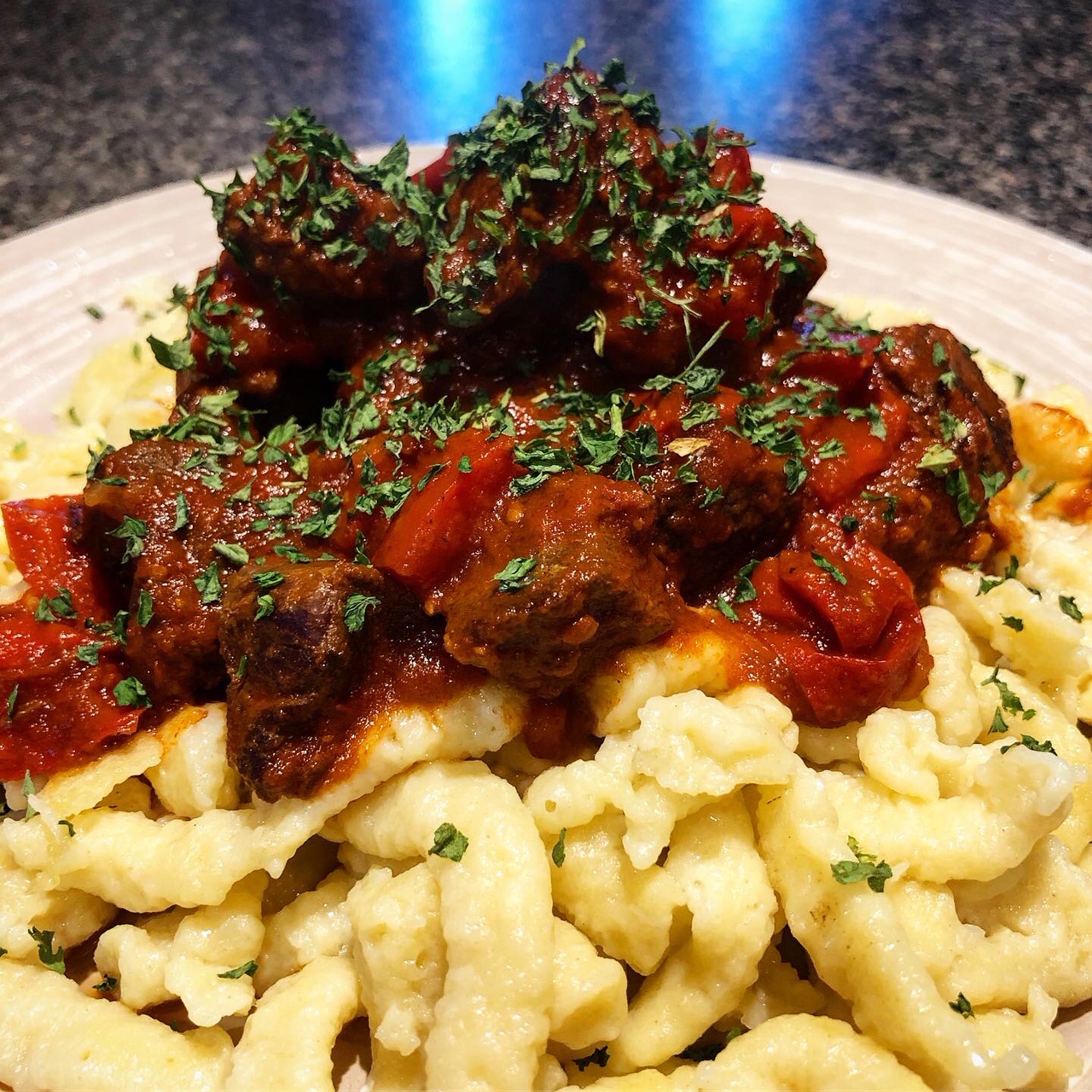
So, Black Bear Bourguignon became the plan. A once rural preparation of stewed onions mushrooms and beef that had been heightened by French masters, and in place of the beef, we were going to insert the bear. Was it as easy as throwing it in a slow cooker? No. Did it take more than half a day to make? Yes. Am I being a food snob? Maybe. But what matters most was that it was good, in fact it was better than good. It was both objectively and subjectively the best wild game dish I’ve ever eaten. The methodical process, the range of ingredients, and the patience needed all make it worth it, and the taste is something you need to experience to understand.

Shot a bear? Make this. It is worth all the efforts and really the bear deserves no less.

Ingredients

8 slices thick bacon, chopped

3 1/2 tablespoons olive oil

3-4 pound bear roast, cubed roughly

2 medium carrots, sliced into coins

1 medium white onion, sliced thinly

2 tablespoons flour

3 cups red wine (authenticity demands Burgundy or Beaujolais, get the real stuff, you won’t regret it)

3 to 4 cups beef stock

1 small can tomato paste

4 cloves mashed garlic

1/2 teaspoon dried thyme

1 bay leaf, crumbled

24-30 pearl onions

3 1/2 tablespoons butter

1 pound mushrooms, fresh and quartered

Salt and pepper

Preparation

  1. Cut the bacon into chunks and begin crisping them in a dutch oven or deep stock pot. Remove to a side dish with a slotted spoon, reserving the fat.
  2. Preheat oven to 450 degrees F (230C).
  3. Ensure the bear cubes are dried. Add the bear to the bacon fat and brown on all sides. Do this in small batches so that the bear meat browns and does not steam in a crowded pot. Remove with a slotted spoon and set aside with the crisp bacon.
  4. In the same bacon (and now bear) fat, brown the carrot and sliced onion. Once done, pour out as much of the fat as you can.
  5. Return the bear and bacon to the pot on top of the vegetables and stir with salt and pepper to taste.
  6. Then sprinkle on the flour and stir to coat the beef lightly. Set pot uncovered in middle position of preheated oven for five minutes.
  7. Stir the meat again and return to oven for four minutes or until the flour is just beginning to brown and make a crust on the meat.
  8. Remove the pot and turn oven down to 325 degrees F (160C).
  9. Pour in the wine and two to three cups beef stock, just enough so that the meat is barely covered.
  10. Add the tomato paste, garlic, and herbs. Bring to a simmer on top of the stove.
  11. Cover pot and return it to the oven. Let this simmers very slowly for four hours. The meat is done when you can tear it easily with a fork.
  12. Go have a glass of any of that wine that may be leftover. You’ve got time.
  13. When the bear meat has one hour left in the oven prepare the pearl onions and mushrooms.
  14. Heat one and a half tablespoons butter with one and one-half tablespoons of the oil in a large pan until the butter is melted and bubbling.
  15. Add the onions and sauté over medium low heat browning them evenly.
  16. Add one half cup of the stock, salt and pepper to taste.
  17. Cover and simmer slowly for 45 minutes until the onions are tender and the liquid has evaporated. If the liquid is gone but the onions are still not tender, add more stock and get back to simmering them.
  18. Set the onions aside, and heat remaining oil and butter over high heat. As soon as you see butter has begun to bubble again, add the mushrooms. Brown them and then set them aside.
  19. When the meat is finished, strain the meat and vegetables, reserving all the cooking liquid.
  20. Put the bear, vegetables, mushrooms, and pearl onions back in the pot.
  21. Skim as much fat as you can off the cooking liquid, and then boil down the sauce for a minute or two, skimming off additional fat as it rises. The sauce should coat a spoon lightly when you are done. Taste for seasoning and add additional salt and pepper.
  22. Pour the reduced cooking liquid over the meat and vegetables. Simmer two to three minutes, stirring to coat the meat and vegetables with the sauce.
  23. Serve with crusty bread or pour over egg noodles.
  24. Dark beer or good red wine are mandatory when eating this.